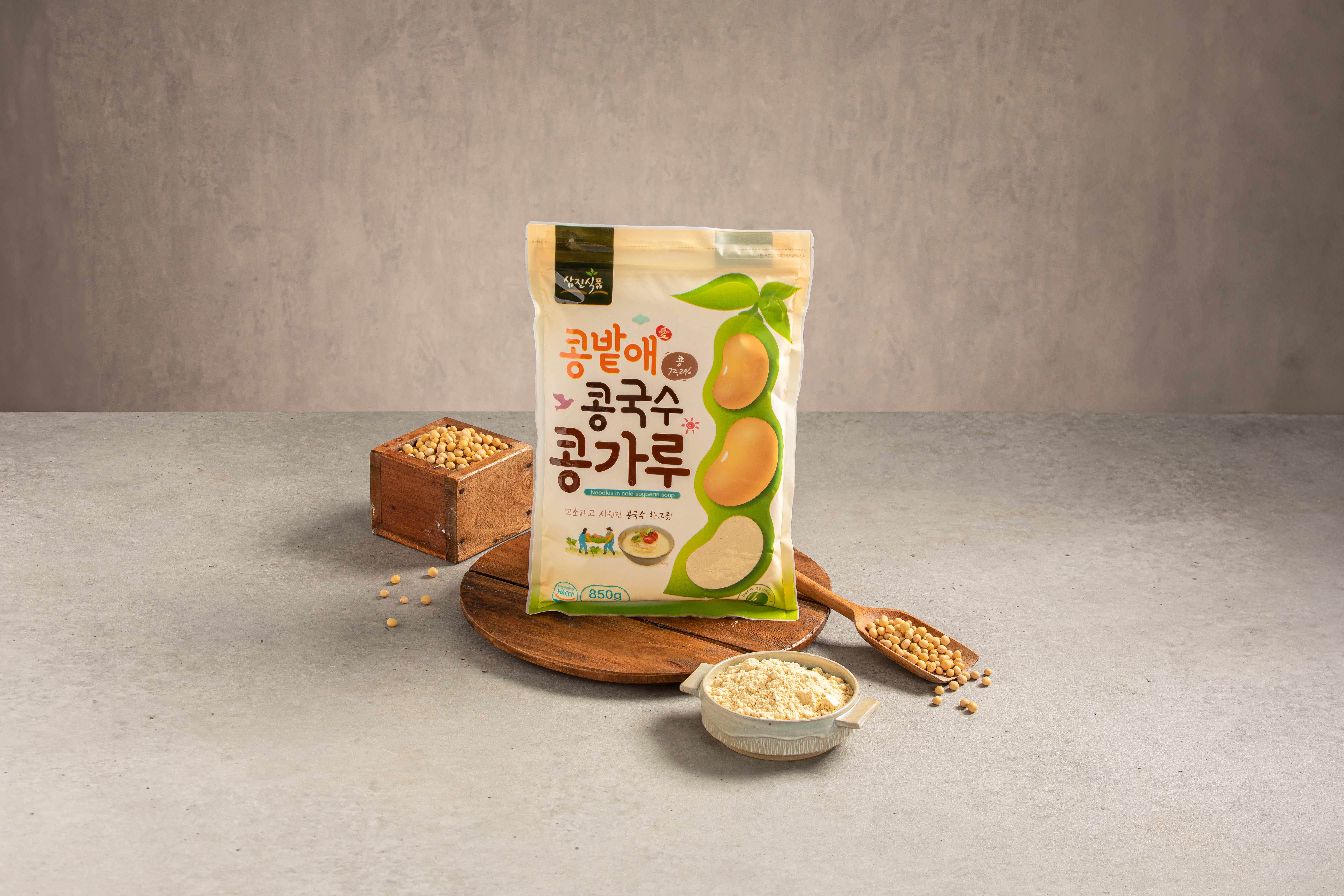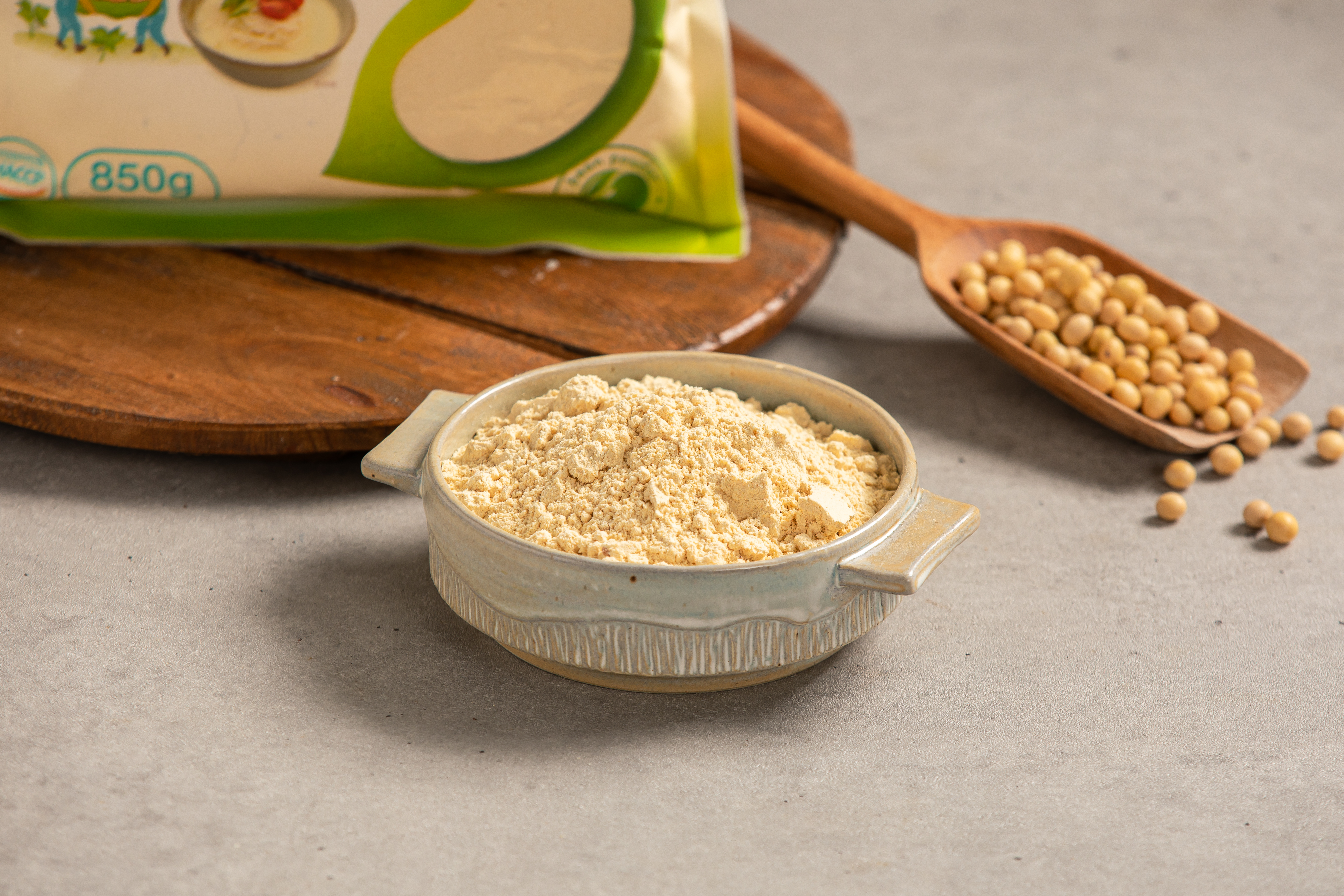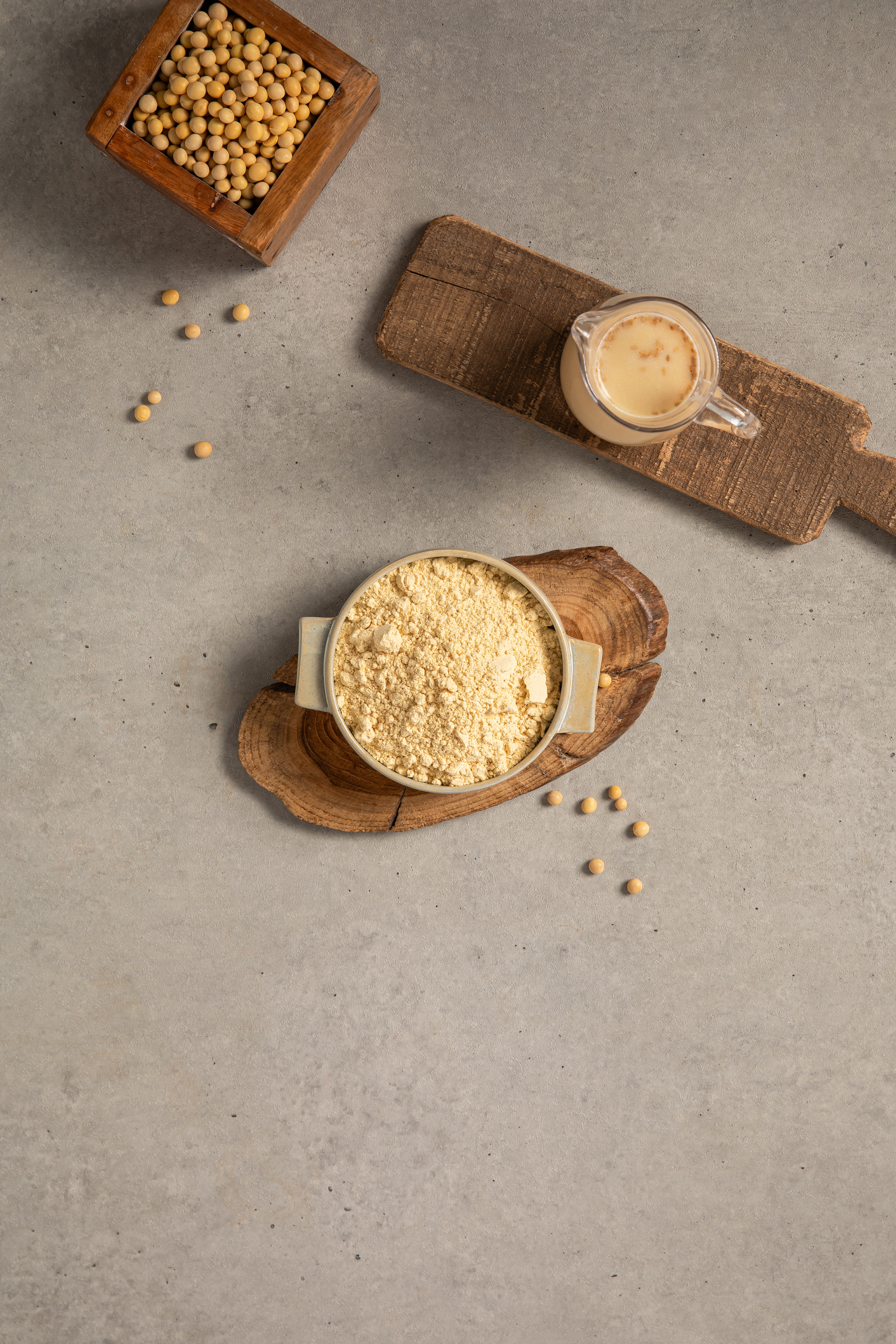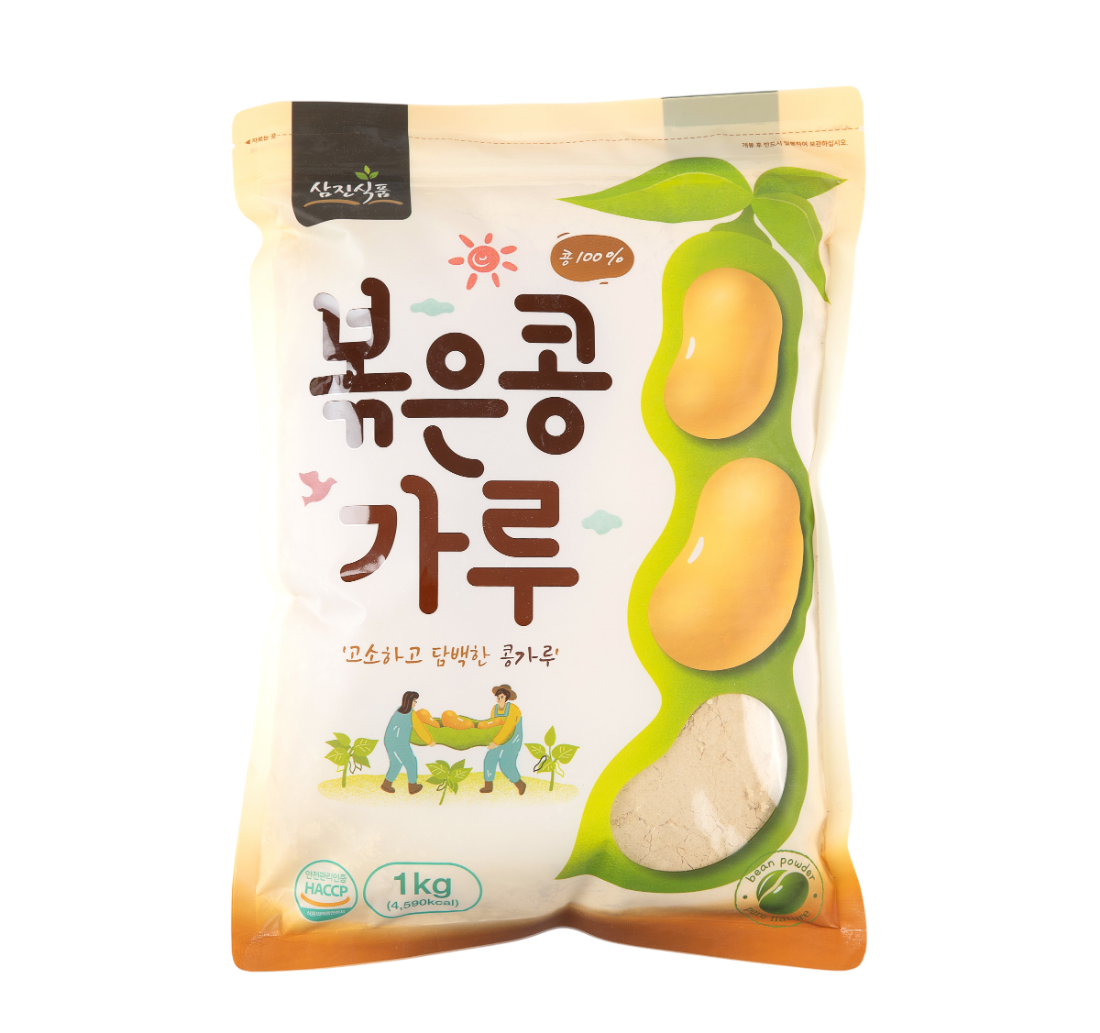
Soybean Powder for Cold Noodle Soup
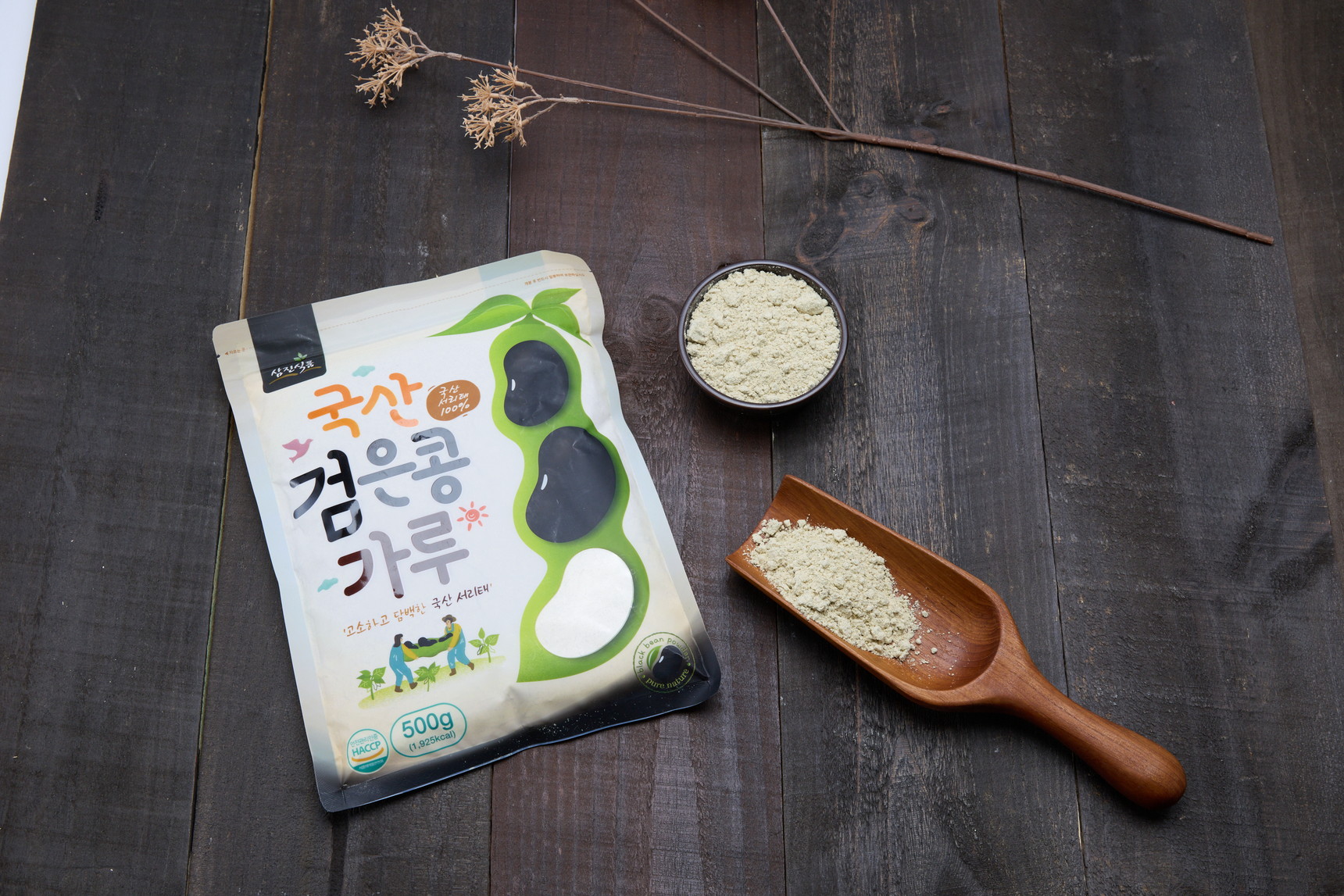
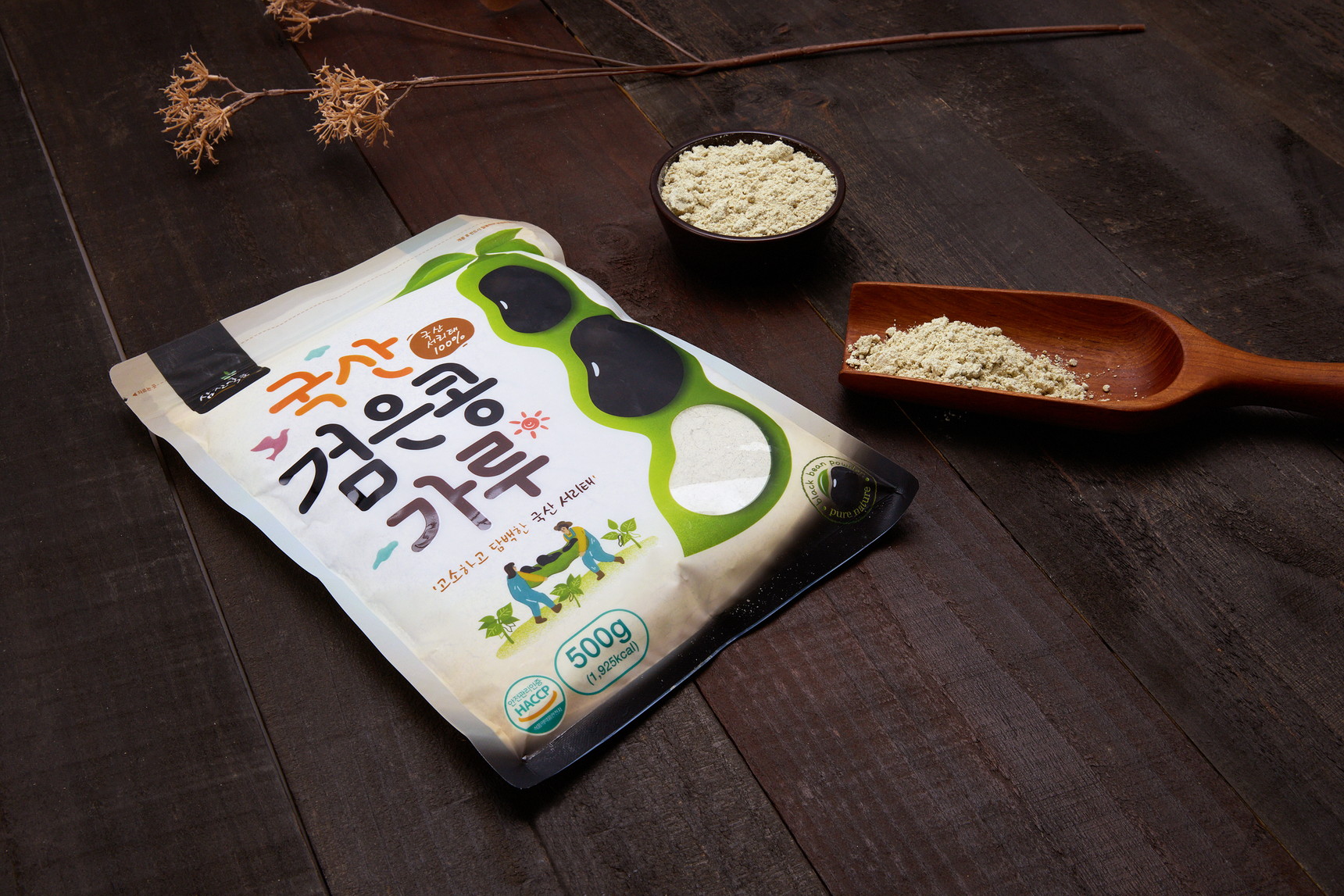
Black Bean Powder
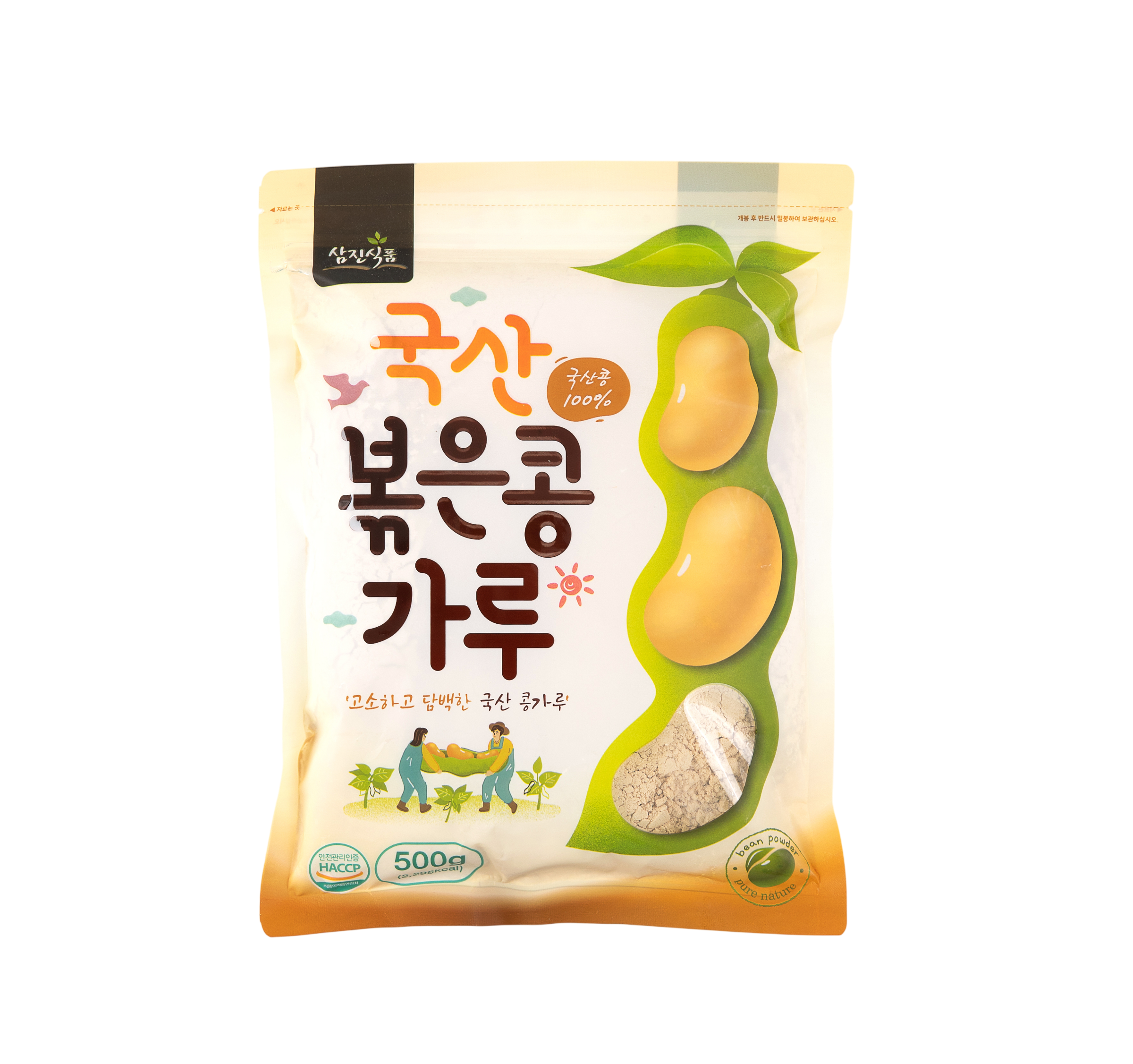
[500g/17.64oz]
Roasted Soybean Flour
Korean Black
Bean Powder
500g (17.6 oz) · 100% seoritae black beans,
roasted and milled in Seongju since 1983
What Is Korean Black Bean Powder?
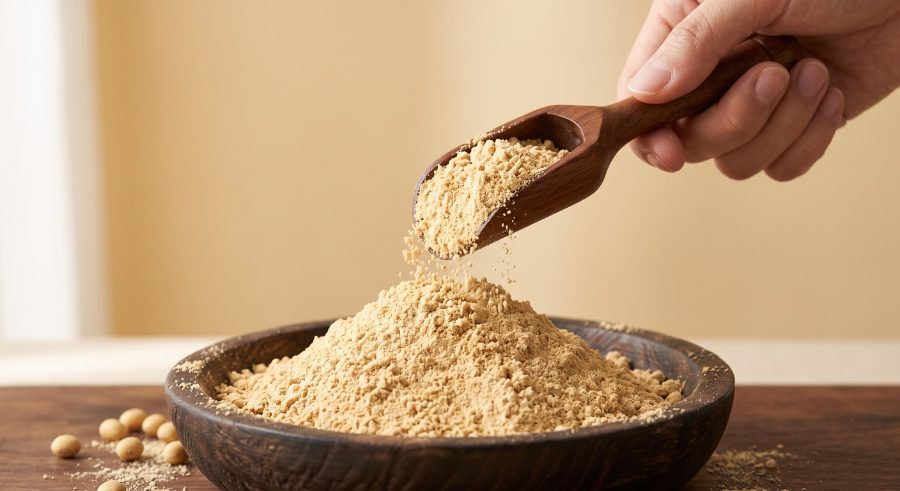
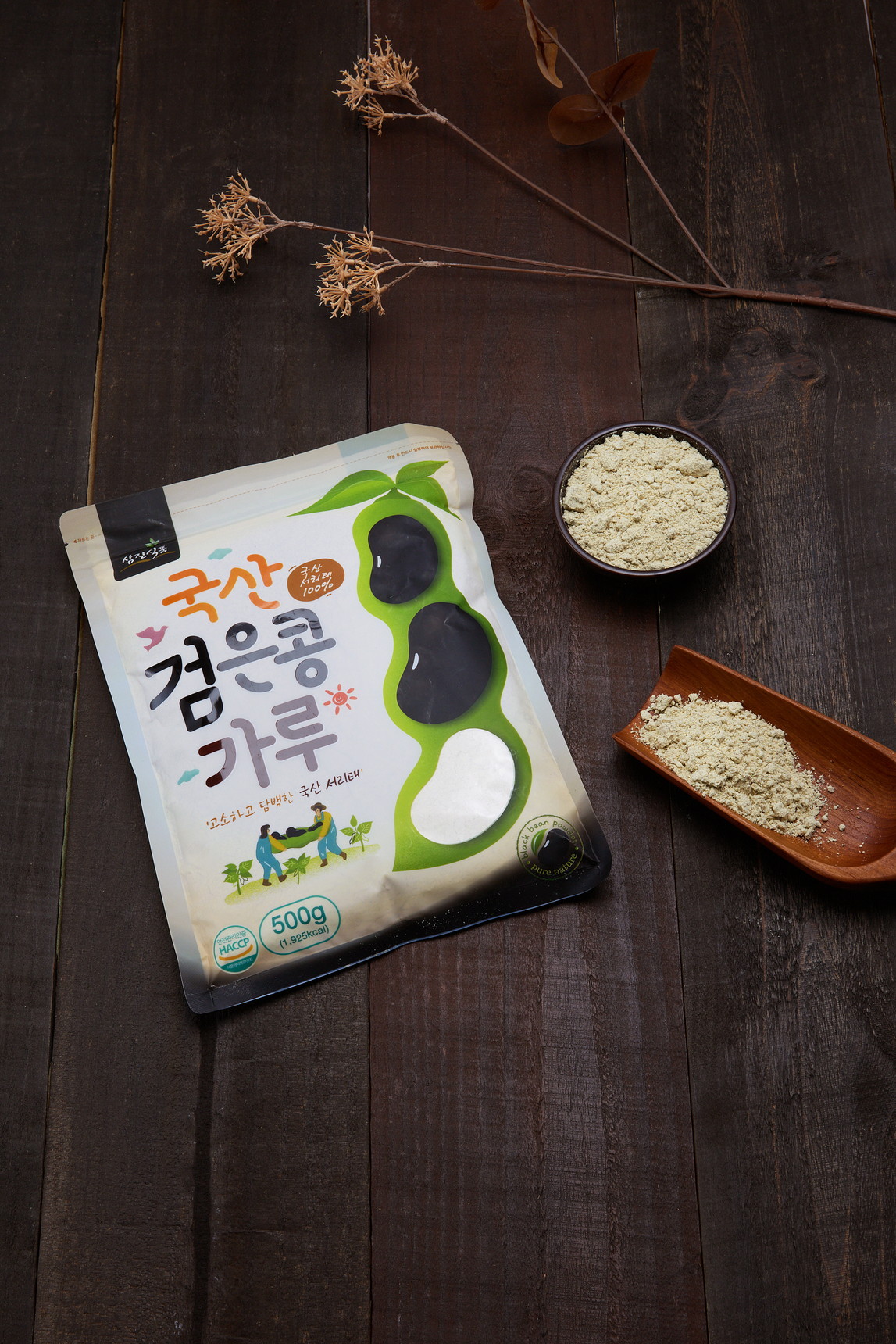
Korean black bean powder — known in Korea as konggaru (콩가루) — is a roasted soybean powder made by toasting whole seoritae black beans and milling them into a fine, nutty flour, used for coating rice cakes, baking, and dusting desserts.
It's the black bean powder Korean kitchens have used for generations — the coating on injeolmi, the dust on bingsu, the nutty swirl in a latte. If you've heard it called bokkeun konggaru — "roasted bean powder" — that's this.
Black Bean Powder vs. Kinako
Kinako is Japan's roasted soybean flour; konggaru is Korea's. Made the same way — whole soybeans, roasted, then milled — so they're interchangeable. This one is the black soybean kinako of Korea: 100% seoritae instead of yellow soybeans, for a deeper, roastier flavor.
Point 1
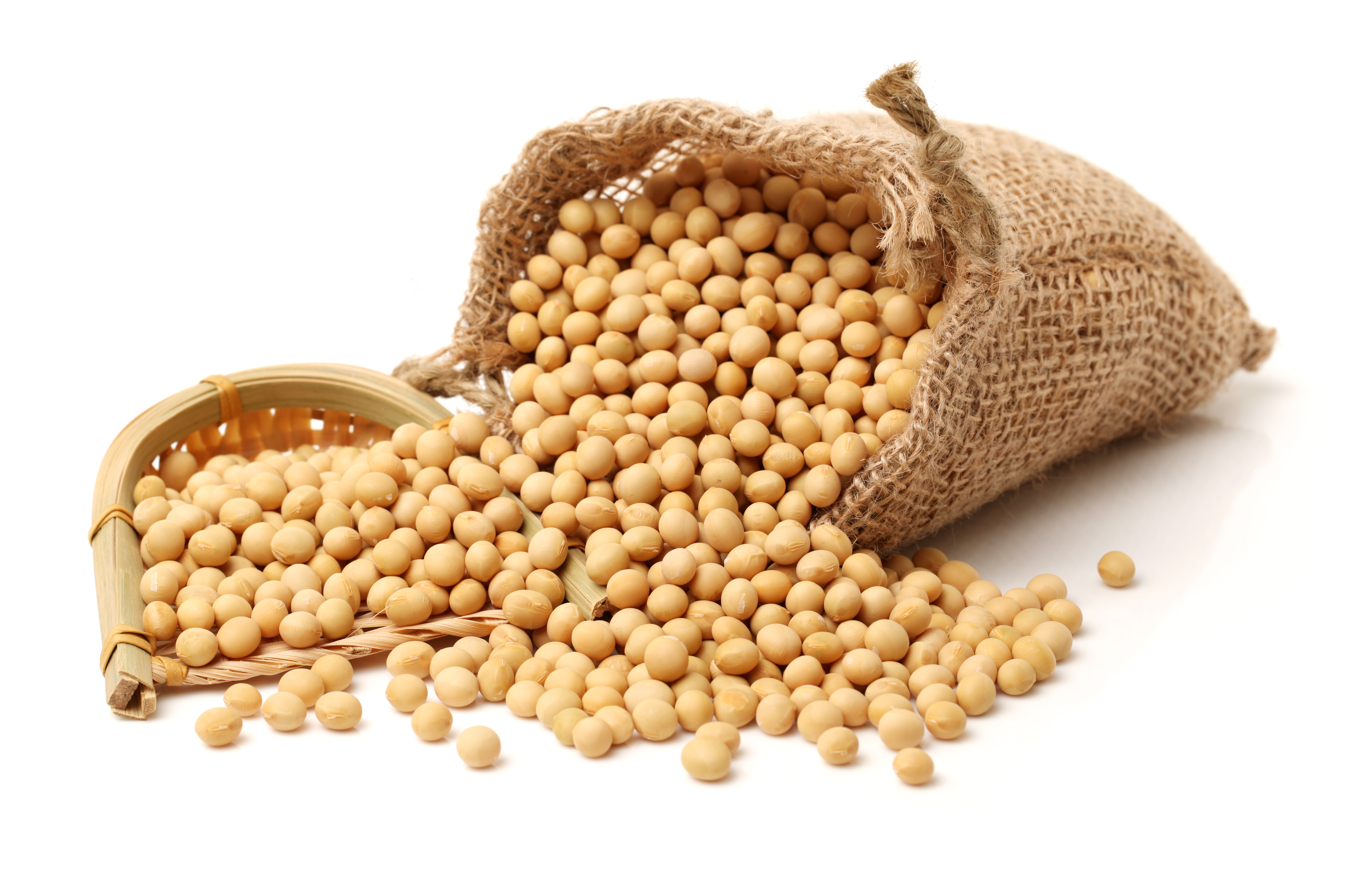
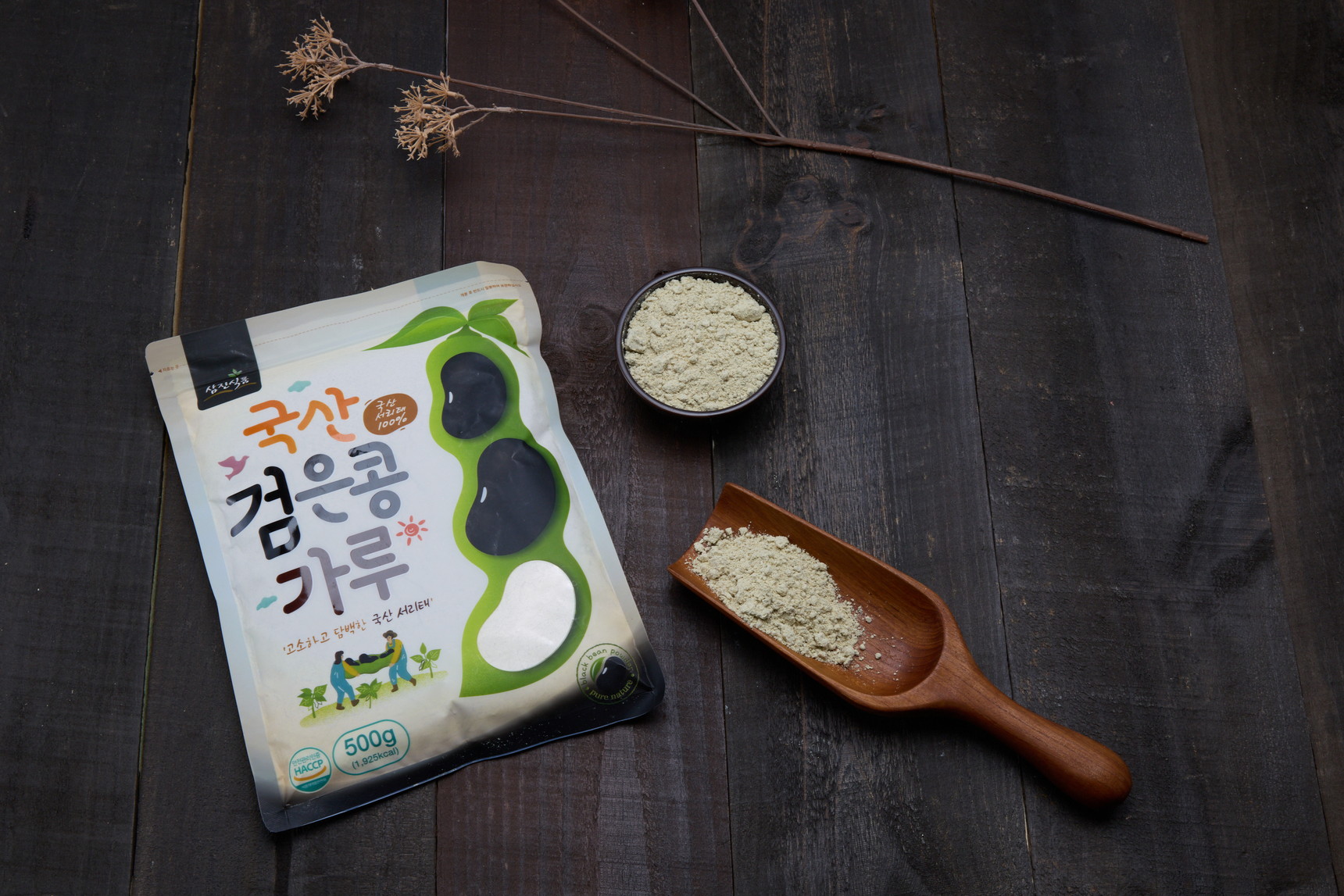
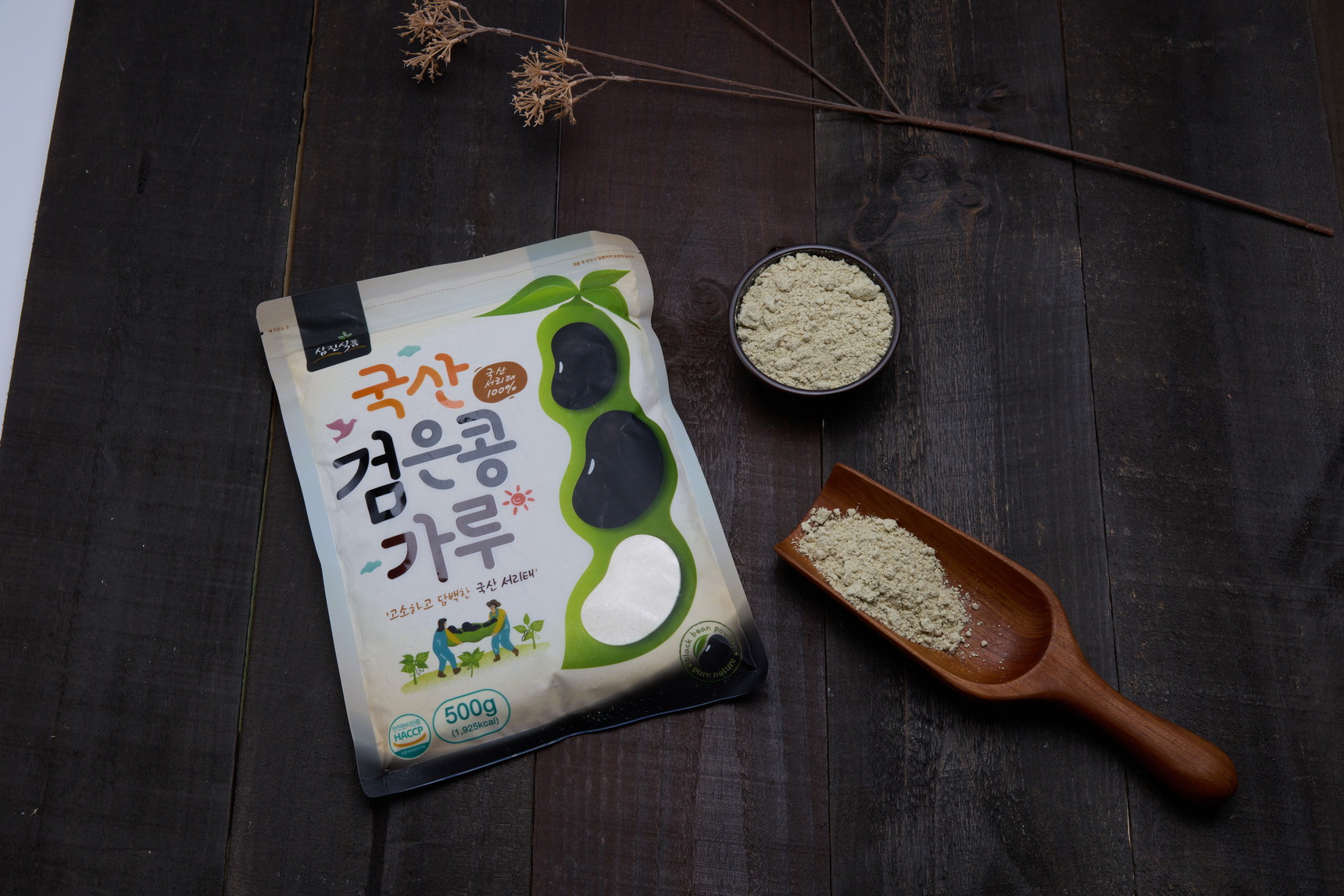
100% Seoritae Black Beans
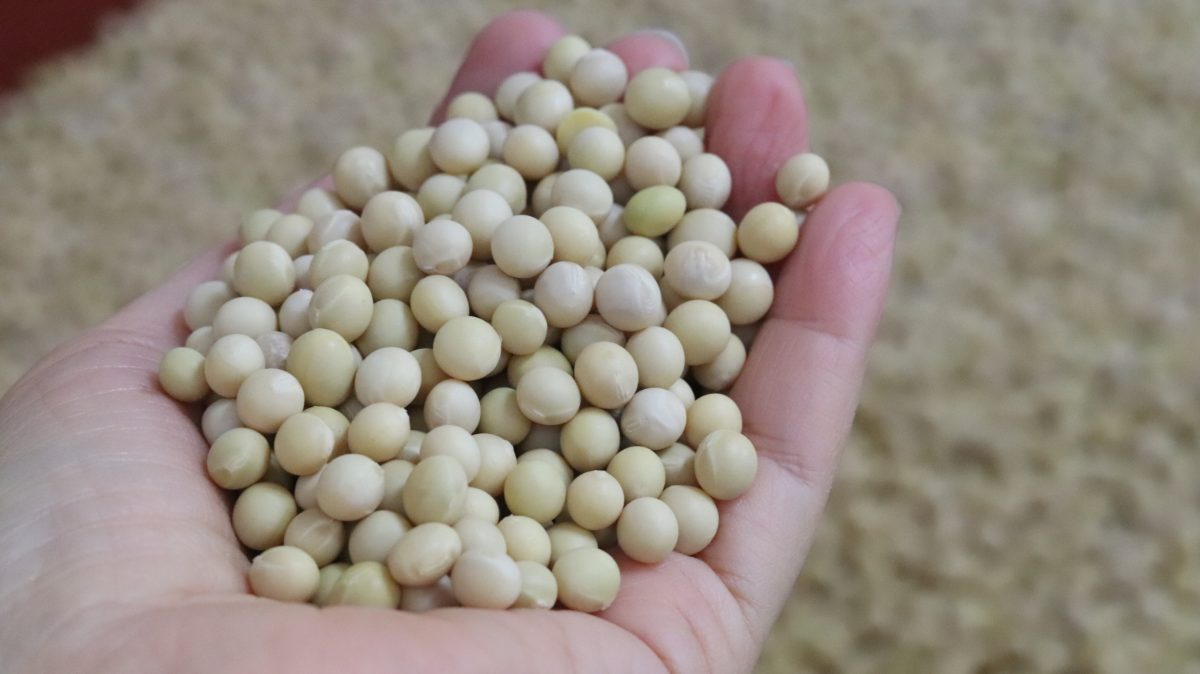
One ingredient, nothing else. Whole Korean-grown seoritae — black skin, green heart — selected and cleaned at the mill in Seongju. Full contents: 100% black soybeans.
Point 2
Roasted Low and Slow, In-House
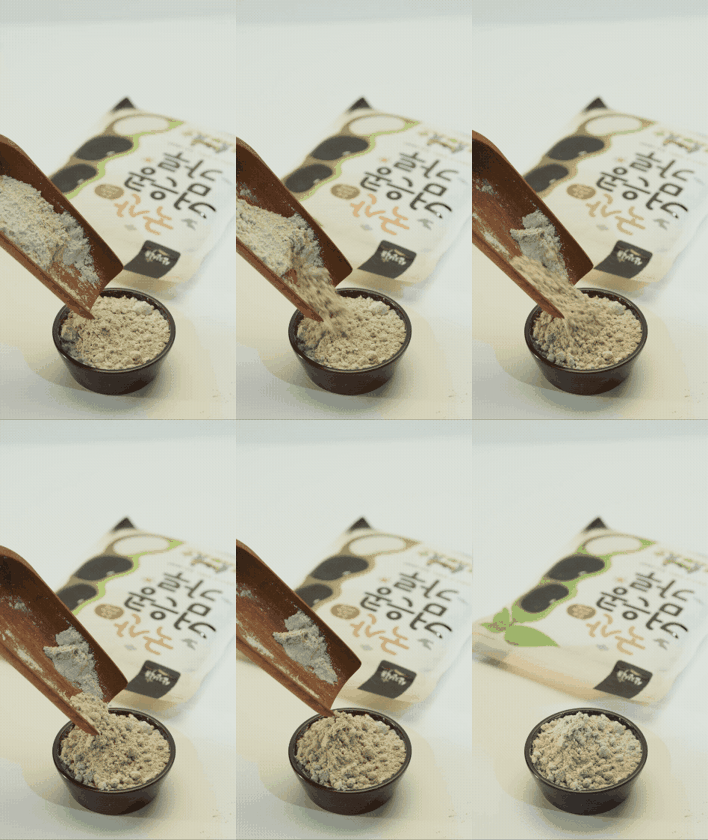
Whole beans are roasted at low temperature in-house, then milled into a fine roasted soybean powder. Slow roasting keeps the nutty aroma deep and the color even.
Nutritional Value
35g of protein per 100g — the beans do the heavy lifting. No added salt, no added sugar: the 7g of sugars is the bean's own.
Values from the product nutrition label, per 100g (3.5 oz). Egg comparison ≈6g protein per large egg, for reference only.
How to Use It
Injeolmi & rice cakes
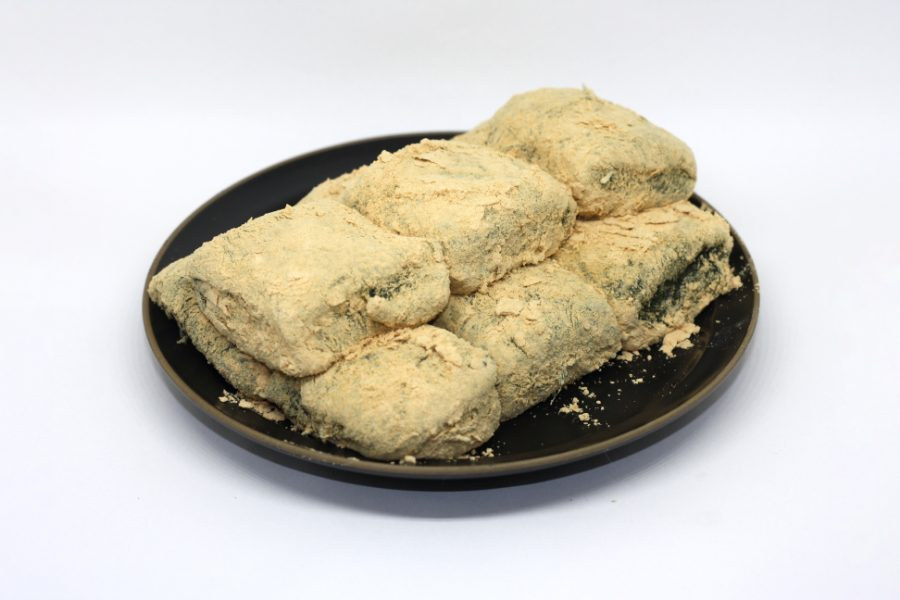
The classic coating for injeolmi; works on any mochi or rice cake where you'd use kinako.
Injeolmi bingsu & toast
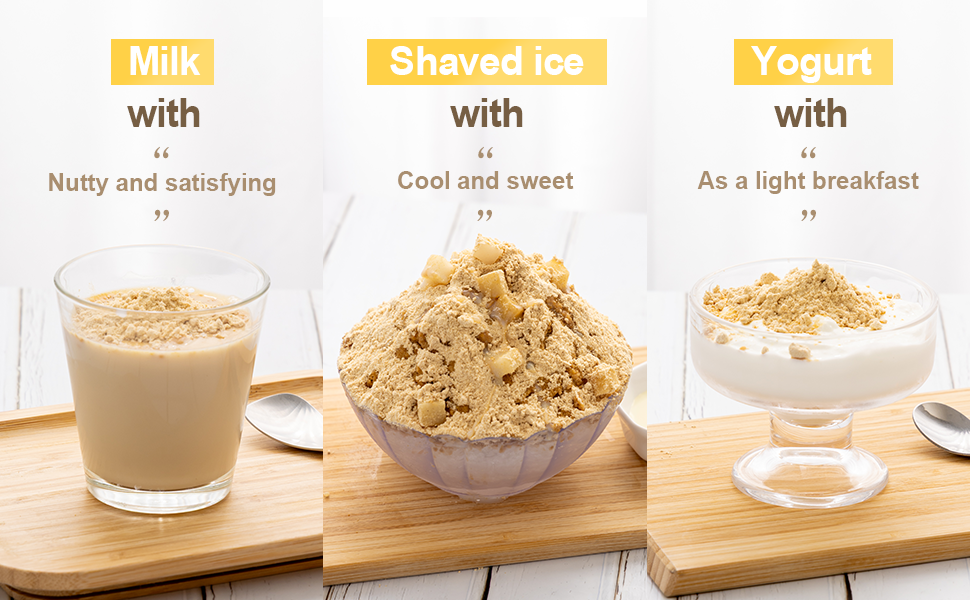
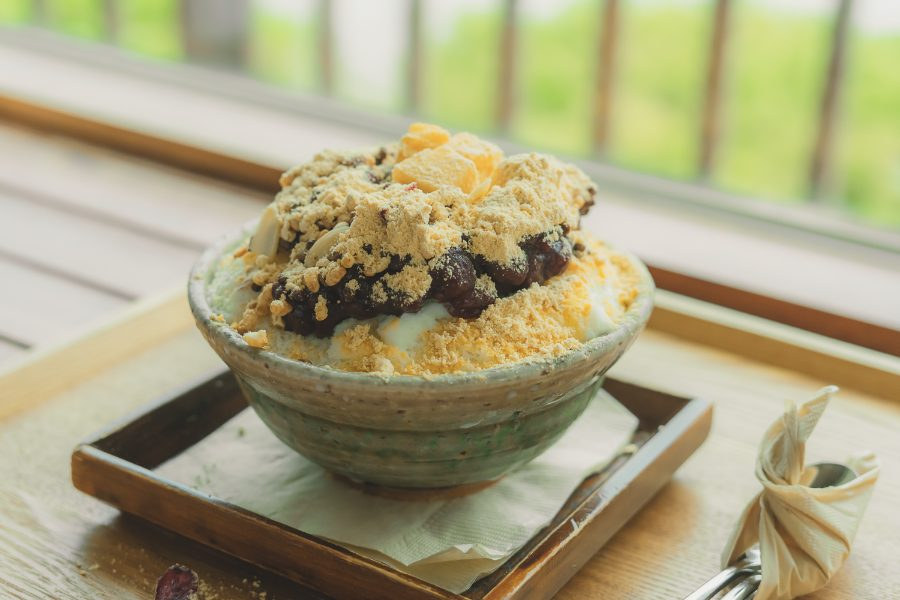
Dust it over shaved ice, or layer with honey between toasted milk bread.
Baking
Swap about ¼ of the wheat flour in cookies and pound cakes; reduce liquids slightly.
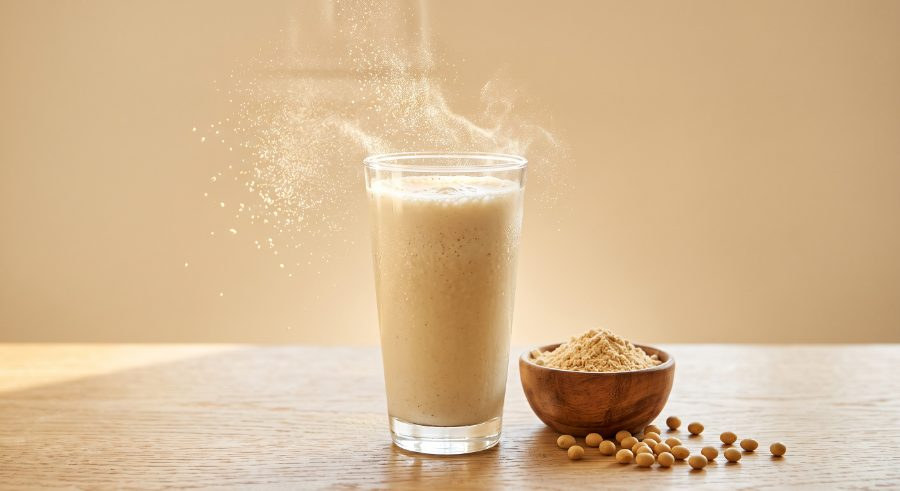
Lattes & smoothies
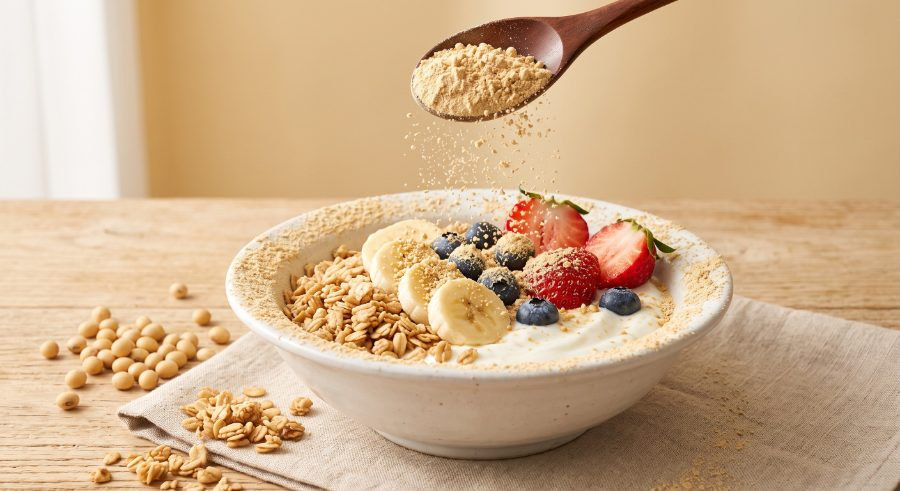
1–2 tablespoons into milk, oat milk, or a banana smoothie.
Yogurt & ice cream
A nutty finishing dust.
Porridge & overnight oats
Stir in for a roasted base note.
Certified, Audited, Verified
<
HACCP

ISO 22000

FSSC 22000

FDA Registered Facility
From Bean to Powder
Select — whole Korean seoritae black beans, cleaned and sorted
Roast — low temperature, in-house, whole beans
Mill — ground fine in small batches at the Seongju facility
Pack — sealed in a resealable zipper pouch, 500g (17.6 oz)
Questions, Answered
Is black bean powder the same as kinako?
Close cousins. Both are roasted soybean flours; kinako is the Japanese name, konggaru the Korean. This one is 100% black soybeans (seoritae).
Can I use this as a kinako substitute?
Yes, one-to-one. Anywhere a recipe calls for kinako, this works — with a deeper roasted flavor.
Is this black bean powder roasted or raw?
Roasted. Whole seoritae beans, low temperature, in-house, then milled.
How much protein is in black bean powder?
35g per 100g, per the nutrition label.
Does it contain allergens?
Contains soybeans. Made in a facility that also processes milk, buckwheat, peanuts, and wheat.
Where can I buy Korean black bean powder?
Right here, and at Korean grocery stores in select regions. For stockists or bulk orders, use the inquiry menu on this site.
How should I store it?
Cool and dry; reseal the zipper pouch and refrigerate after opening.
Do you sell wholesale?
Yes — reach us through the inquiry menu on this site.
Since 1983, Samjin has roasted and milled beans in Seongju, Korea. Roasting, milling, packing — all under one roof.
One Bean, Roasted Well
Korean black bean powder, roasted and milled in Seongju since 1983 —
the black soybean kinako of Korea, from a single ingredient.
Contains soybeans. Made in a facility that also processes milk, buckwheat, peanuts, and wheat.
Looking for a ready-to-drink blend? → Black Bean Mixed Grain Powder (Misugaru)
Sweet Roasted Soybean Powder
[500g/17.64oz]
Soybean Powder for Shaved Ice
[70g/2.47oz]
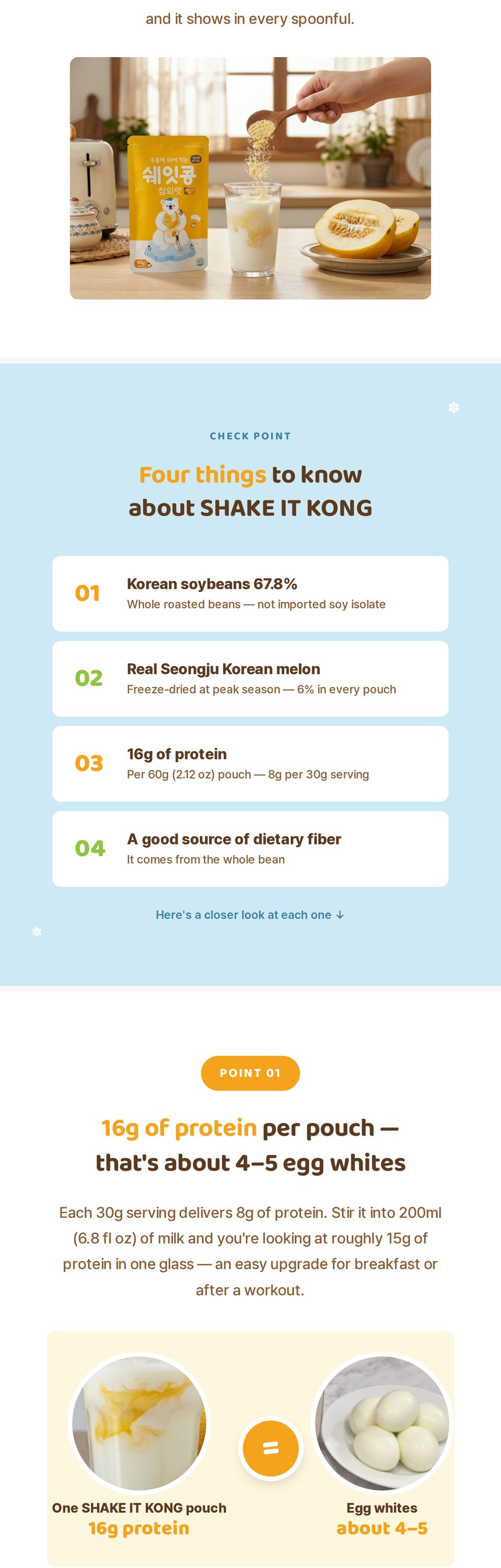
Chocolate Roasted Soy Powder
[60g/2.12oz]
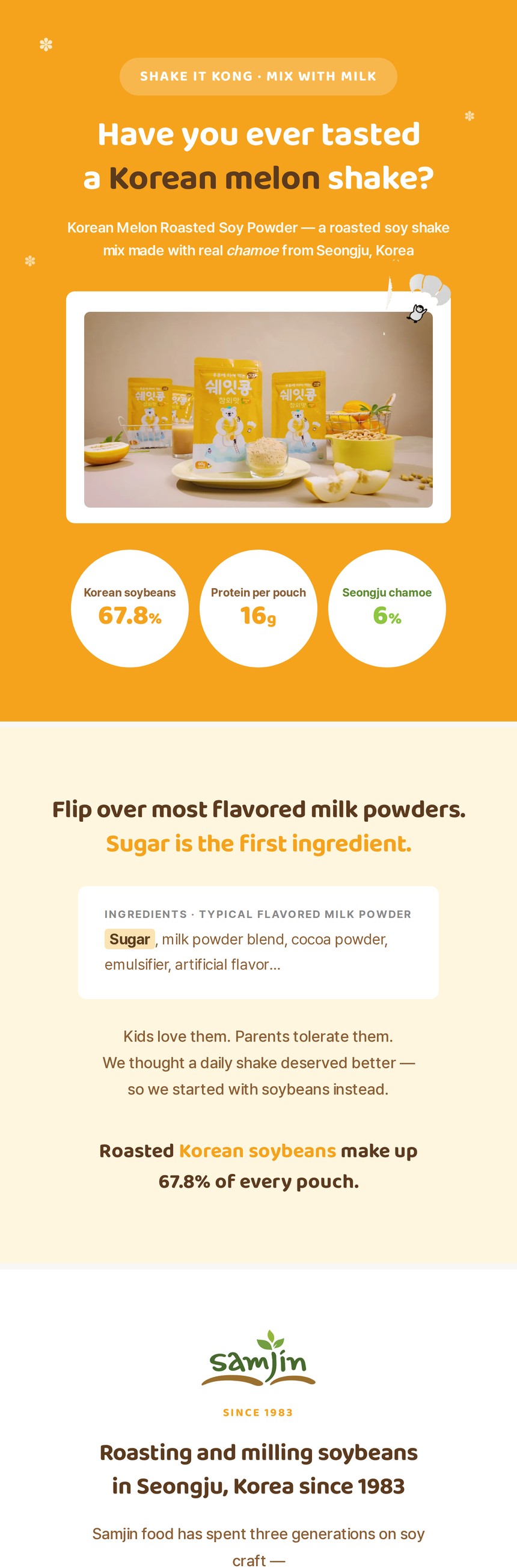
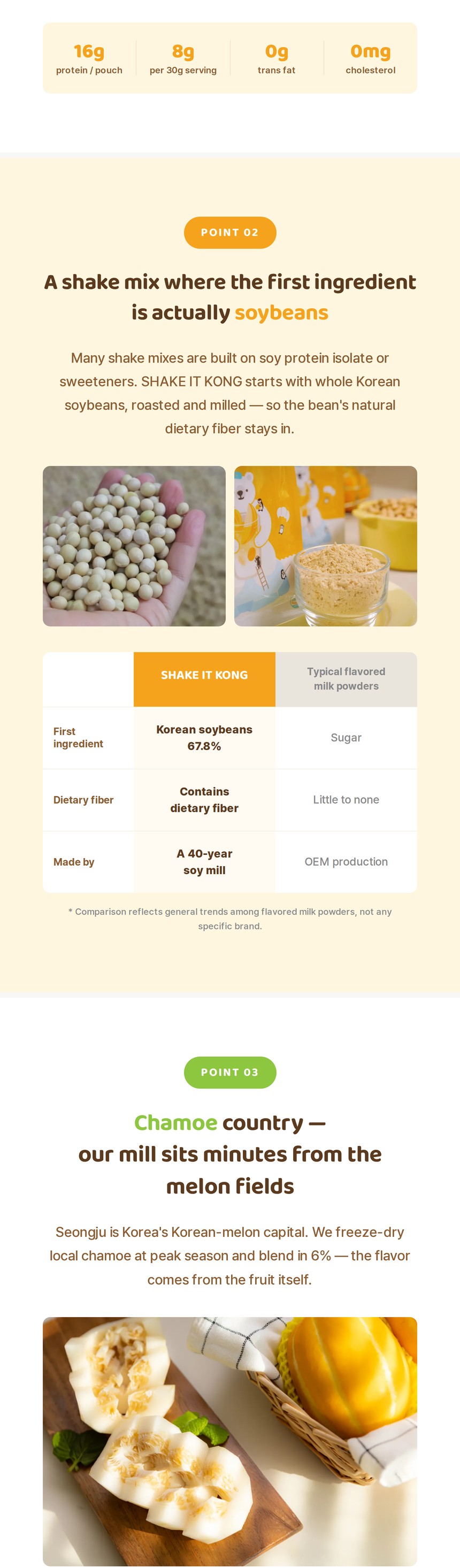
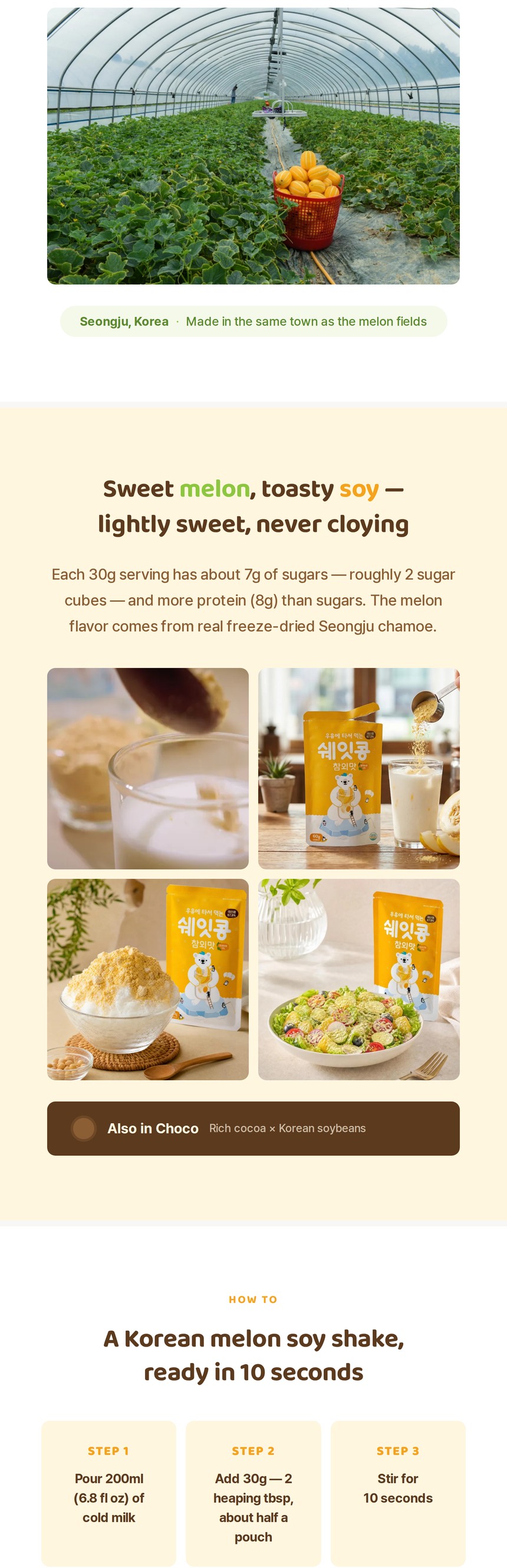
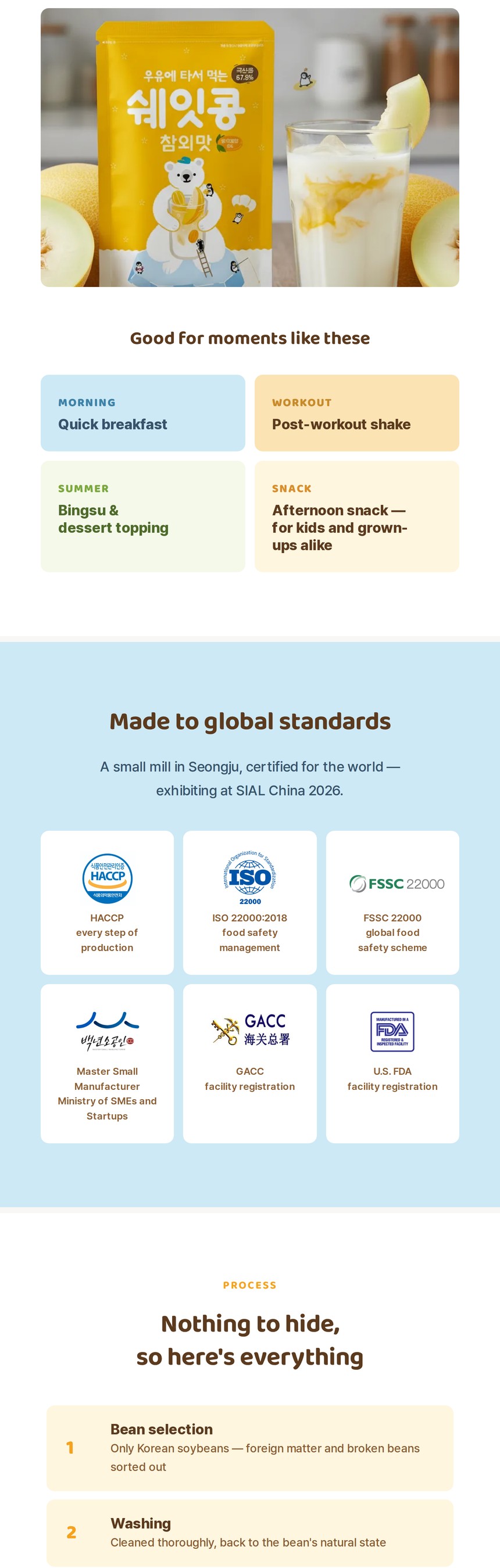
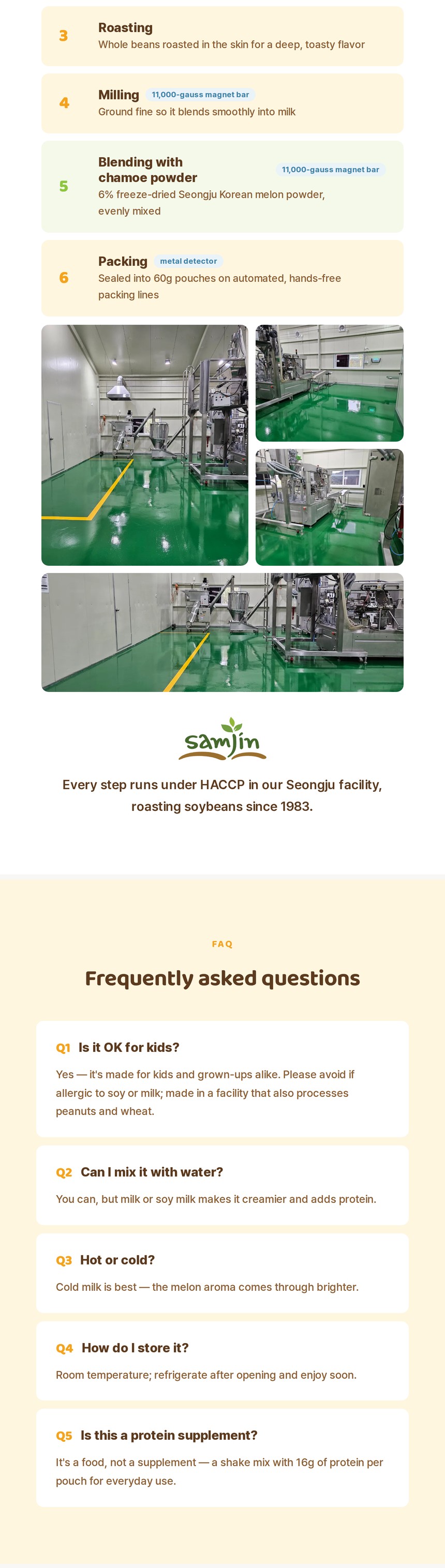
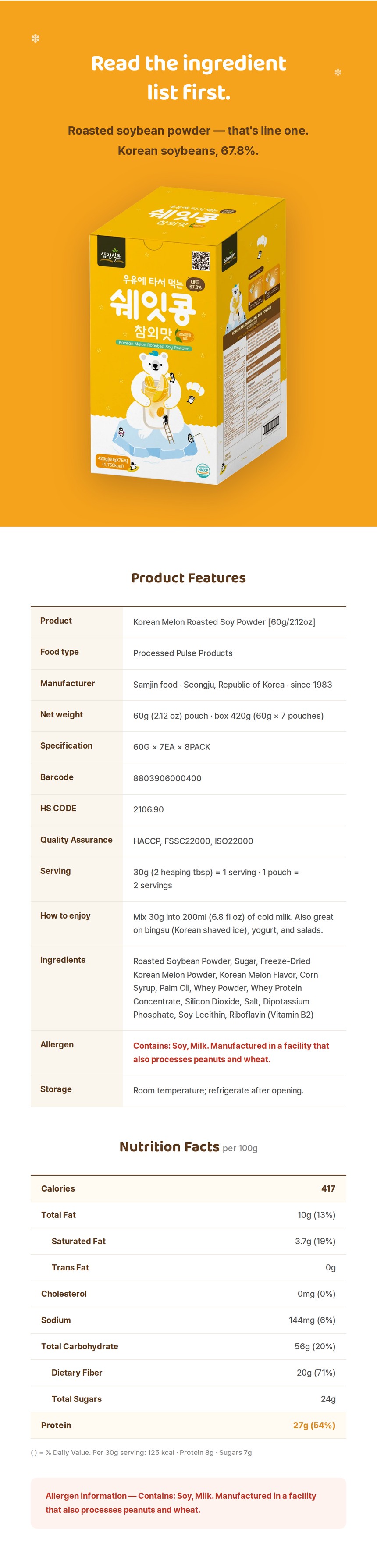
Korean Melon Roasted Soy Powder
[60g/2.12oz]
Sweet Roasted Soybean Powder
[1kg/2.2lb]
삼진식품 콩고물 1kg은 인절미·떡·제과의 부재료로 사용하는 두류가공품입니다. 1kg 대용량 포장으로 떡집·식당·제과 매장에서 효율적으로 사용할 수 있도록 가공한 제품입니다.
인절미·찹쌀떡·콩가루떡 등 전통 떡류의 풍미는 콩고물의 품질이 좌우합니다.삼진식품 콩고물은 깨끗하게 세척한 대두를 직화 로스팅한 후 미세하게 분쇄하여 콩 본연의 고소한 향이 살아 있는 인절미가루로 가공됩니다.
떡류 부재료 외에도 콩가루 빵·콩가루 라떼·인절미 토핑 등 다양한 메뉴에 활용 가능하며, 1kg 대용량으로 보관과 사용이 편리합니다.
본 제품은 HACCP·FSSC22000 인증을 받은 삼진식품 제조 시설에서 생산되며, 1983년부터 곡물가공 분야에서 축적된 기술로 만들어진 콩고물입니다.
Roasted Soybean Powder
[500g/17.64oz]
Samjin food · Since 1983
Roasted Soybean Powder500g / 17.6 oz
Made from soybeans grown in Korea, roasted and finely milled. No sugar, no salt, nothing else added.
About
Roasted soybean powder made from one ingredient
Yellow soybeans are roasted whole in a kettle, then ground into a fine golden powder. The ingredient line reads simply: soybeans, 100%. There is no sugar, no salt, no flavouring and no preservative, so what you taste is the bean itself. In Japan this ingredient is called kinako; in Korea it is bokkeun kong-garu.
Because nothing is seasoned, the seasoning is left to you. Sweeten it with honey or sugar, or leave it plain — either way works only when the ingredient list is this short.
Origin
Grown in Korea, milled in Korea
Every soybean in this pouch is grown in Korea. Beans are sourced from domestic farms and brought to our own plant in Seongju, Gyeongsangbuk-do, where sorting, roasting, milling and packing all happen under one roof. Nothing is blended in from abroad, which is why the front of the pack states 100% Korean soybeans without qualification.
With a single-ingredient food, where that one ingredient comes from is the whole of its quality. This size exists for buyers who choose by origin.
Roasting
Kettle-roasted, the traditional way
The beans are roasted in electric kettles — the old Korean method of pan-roasting in a cauldron, with the heat source switched to electricity. Beans touch the kettle surface directly, which is where the toasty aroma comes from, while steady electric heat keeps them evenly roasted rather than scorched. They are milled in the same facility before they cool. The shorter the gap between roasting and milling, the less aroma is lost.
Nutrition
34g protein, 2mg sodium
34g
Protein per 100g — roughly a third of its weight
2mg
Sodium per 100g — the number you get when no salt goes in
The 8g of sugars on the label is not added sugar. It occurs naturally in the beans. When nothing is put in, the numbers simply describe the ingredient.
* Values from the product nutrition label, per 100g.
How to Use
Four ways to use roasted soybean powder
No cooking required — stir it in or dust it over. Press the zipper closed after opening and the aroma keeps until next time.


Check
Roasted soybean powder is not raw soybean flour
This product is fully roasted and ready to eat as it is. Raw (uncooked) soybean flour is a separate ingredient, used in Korean noodle doughs and in cabbage soup, and it must be cooked — if that is what a recipe calls for, look for raw soybean flour instead. For rice cake coatings, drinks and toppings, where nothing will be cooked afterwards, this roasted version is the one you want.
Certification
Made in a certified facility

HACCP

ISO 22000

FSSC 22000

Century Craftsman

China GACC

FDA Registered
Process
Seven steps to the pouch
Milled to 140 mesh, passed twice through 11,000-gauss magnet bars, then checked once more by metal detector.
01
Sorting
02
Washing
03
Kettle roasting
04
Milling (140 mesh)
05
Magnet bars ×2
06
Metal detection
07
Zipper pouch
FAQ
Frequently asked questions
Q. Is this the same as kinako?
A. Yes. Kinako is the Japanese name for roasted soybean flour. This is the Korean version, made from 100% roasted soybeans with nothing added, so it works in any recipe calling for kinako.
Q. Is it raw or roasted?
A. Fully roasted. Raw soybean flour is a different ingredient that needs cooking; this one is ready to eat straight from the pouch.
Q. How is it different from sweetened soybean powder?
A. Sweetened versions have sugar and salt mixed in. This is soybeans only, unseasoned, so you can sweeten it yourself and use it the same way.
Q. How should I store it?
A. Room temperature before opening, away from direct sunlight. After opening, press the zipper closed and refrigerate to keep the aroma.
Q. Does it contain allergens?
A. It contains soybeans. It is made in a facility that also processes milk, buckwheat, peanuts and wheat.
Q. Can I see the test reports?
A. Self-inspection test reports are published in our resource library and open to anyone. samjinfoods.com/pds
Roasted Soybean Powder
[1kg/2.2lb]
Samjin food · Since 1983
Roasted Soybean Powder1kg / 2.2 lb
100% roasted soybean powder — no sugar, no salt, no additives. Just soybeans, kettle-roasted and finely milled in Korea.
About
What is roasted soybean powder?
Roasted soybean powder is a fine flour made by dry-roasting whole yellow soybeans and grinding them into a nutty, golden powder — the same ingredient known as kinako in Japan and bokkeun kong-garu in Korea.
This Korean roasted soybean powder is made from a single ingredient: soybeans. Nothing is added — no sugar, no salt, no preservatives. It is roasted and milled in our own facility in Seongju, Korea, and shipped fresh.
A family-run mill in Seongju, Korea, roasting and grinding grains and beans since 1983.
We process everything in our own facility — the same way, in the same place, for over 40 years.
Check Point
100% soybean, nothing added
34g protein per 100g
Kettle-roasted in Korea
Made in a certified facility
Ingredient
One line on the label
Ingredients: soybeans 100%. Whole beans are roasted and milled at our own facility in Korea — not bought in as pre-ground powder.
Roasting
Kettle-roasted, the traditional way
We roast the beans in electric kettles — the traditional Korean method of pan-roasting in a cauldron, with the heat source switched to electricity. The beans touch the kettle surface directly, while precise temperature control keeps them evenly roasted, never burnt. The roasted beans are milled right away, in the same facility.
Nutrition Facts
One-third of its weight is protein
34g
Protein per 100g
2mg
Sodium per 100g — nothing added, and the numbers show it
* Values from the product nutrition label, per 100g.
Taste
Nutty, plain, and honest
The flavor is toasty and nutty with a mild natural sweetness — the 8g of sugars per 100g come from the soybeans themselves, not from added sugar. Because nothing is seasoned, you decide how to use it: sweeten it, salt it, or keep it plain.
How to Use
How to use roasted soybean powder
1. Add 2–3 tbsp
2. Pour milk or water
3. Stir or shake
4. Enjoy


Certification
Certified facility

HACCP

ISO 22000

FSSC 22000

FDA Registered
Also registered with China GACC for export.
Process
From bean to powder, in one facility
01
Sorting
02
Washing
03
Kettle roasting
04
Fine milling
05
Magnet bars
06
Metal detection
07
Packing
FAQ
Frequently asked questions
Is roasted soybean powder the same as kinako?
Yes — kinako is the Japanese name for roasted soybean flour. This is the Korean version, made from 100% roasted soybeans with nothing added, so it can be used in any recipe that calls for kinako.
Is it raw or roasted soybean flour?
Fully roasted. Raw (uncooked) soybean flour is a different ingredient used in some Korean noodle doughs and soups — this product is dry-roasted, so it is ready to eat as is.
Does it contain sugar or additives?
No. The only ingredient is soybeans. The small amount of sugars on the nutrition label occurs naturally in the beans.
How should I store it?
Store at room temperature. After opening, keep it sealed and refrigerated for the best flavor.
Does it contain allergens?
This product contains soybeans. It is made in a facility that also processes milk, buckwheat, peanuts, and wheat.
Product Details
Specifications
| Product | Roasted Soybean Powder |
|---|---|
| Net weight | 1kg (2.2 lb / 35.3 oz) |
| Ingredients | Soybeans 100% · contains soybeans |
| Type | Processed bean product (powder) |
| Storage | Room temperature; refrigerate after opening |
| Allergen info | Contains soybeans. Made in a facility that also processes milk, buckwheat, peanuts, and wheat. |
| Manufacturer | Samjin food, Seongju-gun, Gyeongsangbuk-do, Republic of Korea |
Nutrition (per 100g)
| Calories | 459 kcal |
|---|---|
| Protein | 34 g |
| Fat | 19 g (saturated 3 g, trans 0 g) |
| Cholesterol | 0 mg |
| Carbohydrate | 37 g (sugars 8 g — naturally occurring) |
| Sodium | 2 mg |
* Values from the product nutrition label, per 100g.
Looking for other Korean grain powders? See our black bean powder and misugaru (mixed grain powder).
Roasted Soybean Powder
[1kg/2.2lb]
Raw Soybean Powder
[1kg/2.2lb]
Raw Soybean Powder
[1kg/2.2lb]
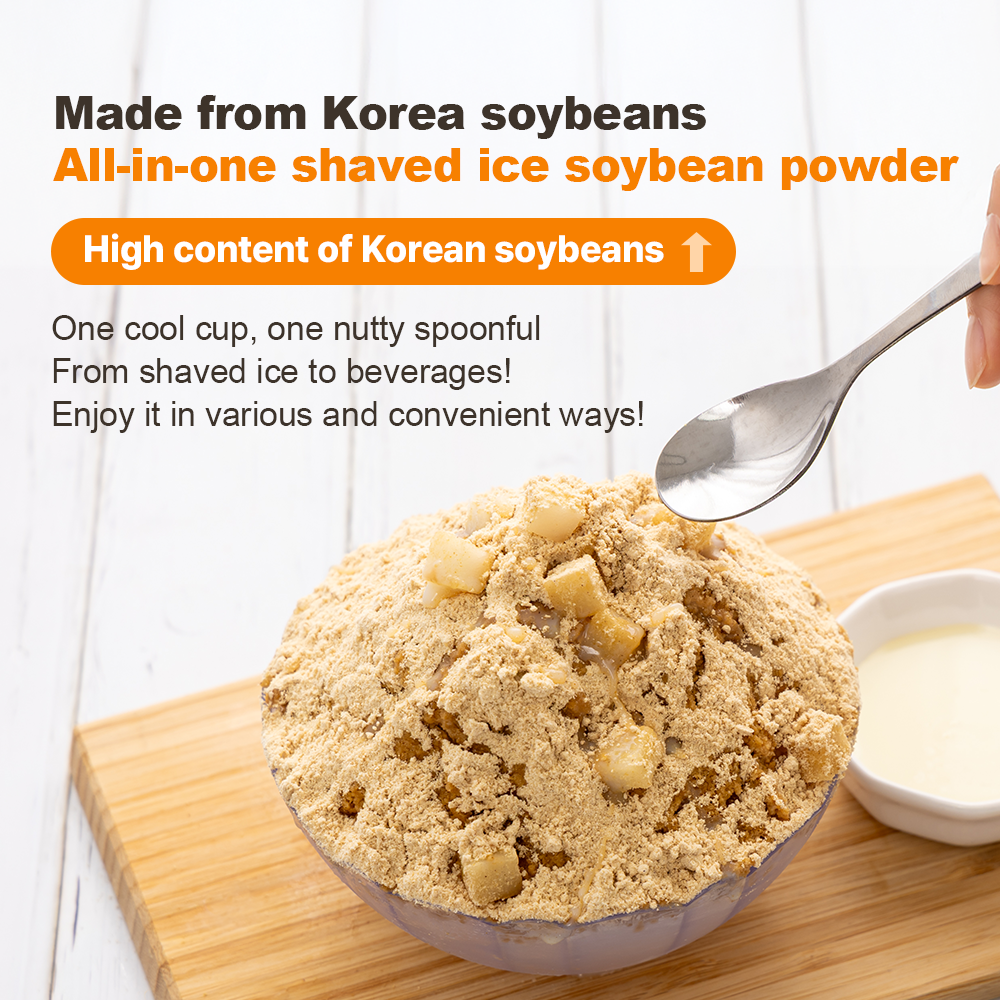
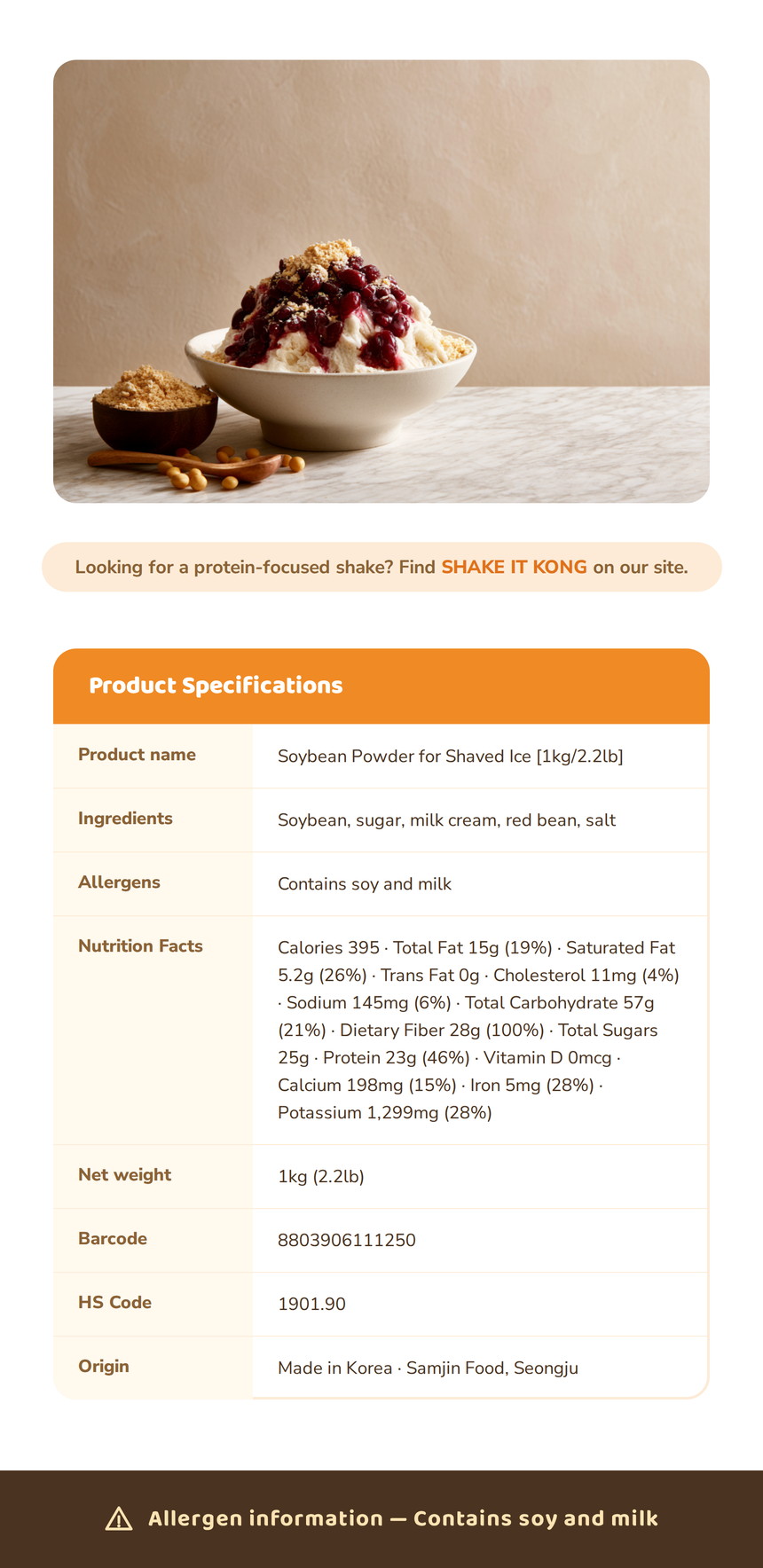
Soybean Powder for Shaved Ice
[1kg/2.2lb]
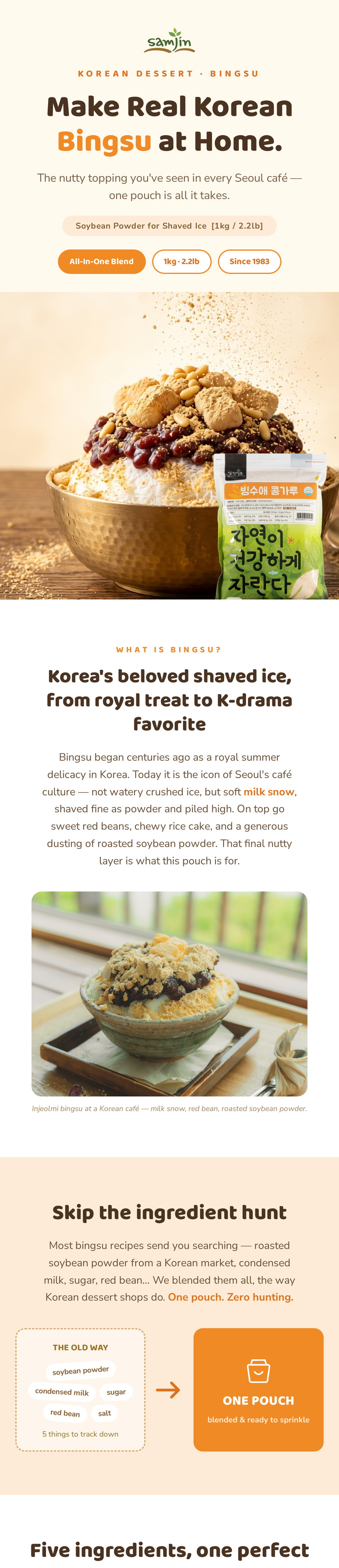
Make Real Korean Bingsu at Home.
The nutty topping you've seen in every Seoul café — one pouch is all it takes.
Korea's beloved shaved ice, from royal treat to K-drama favorite
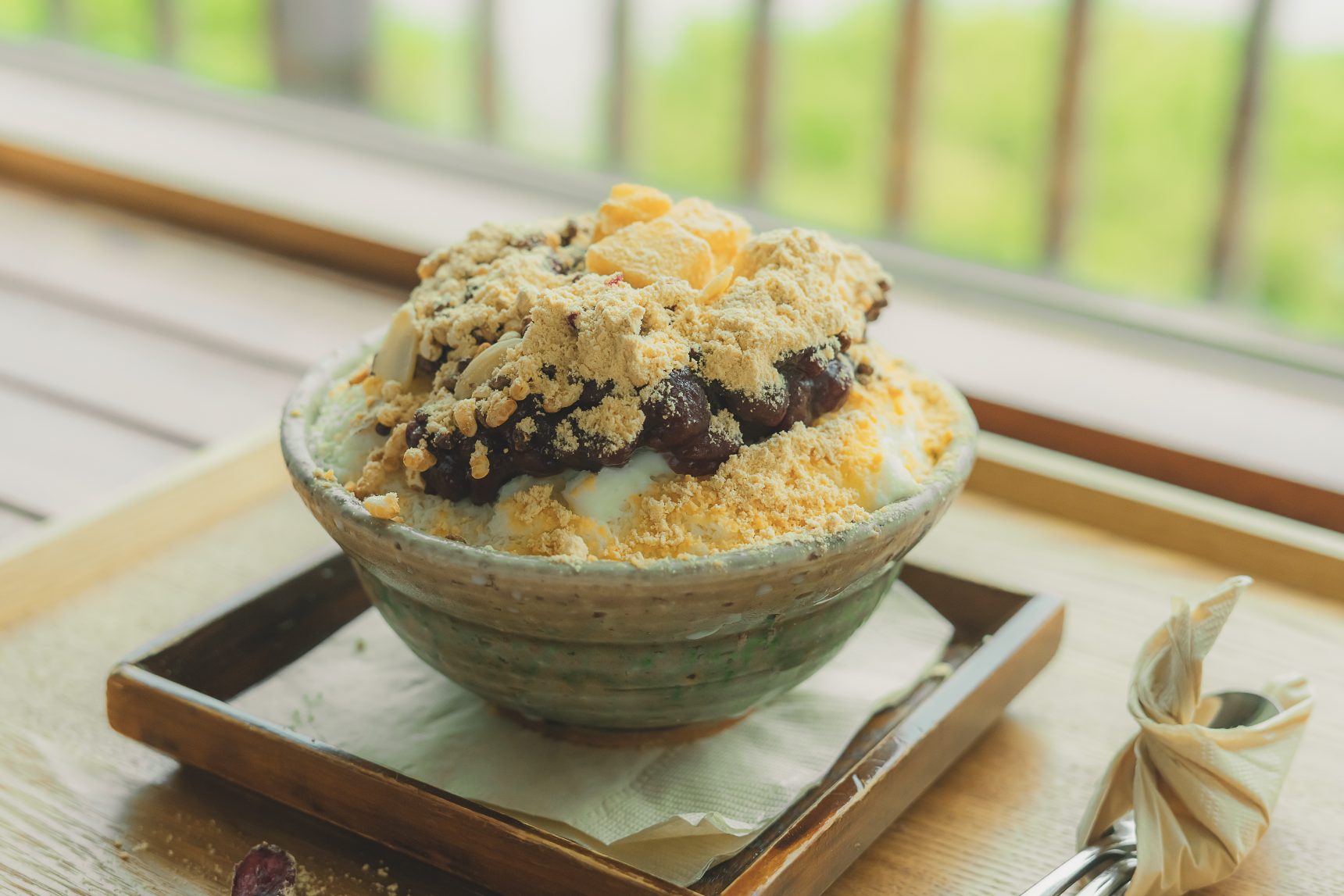
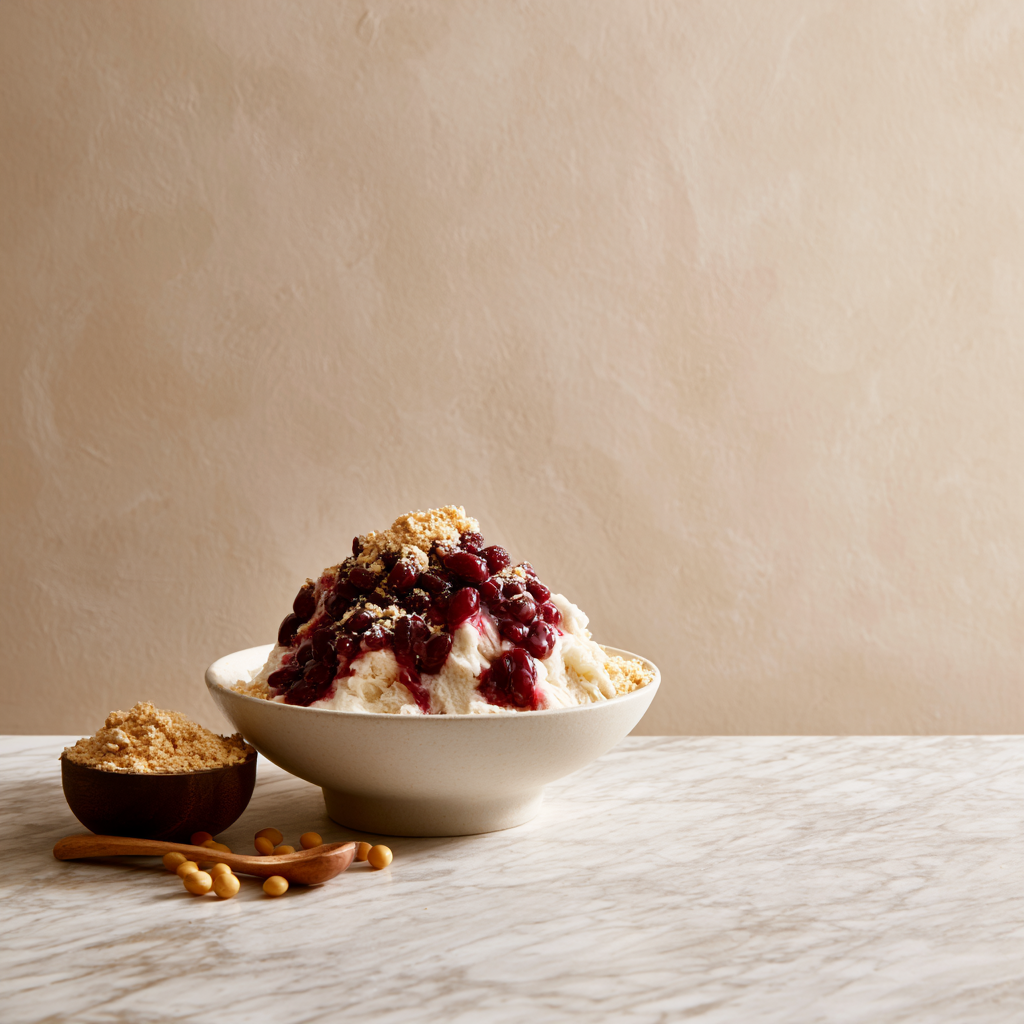
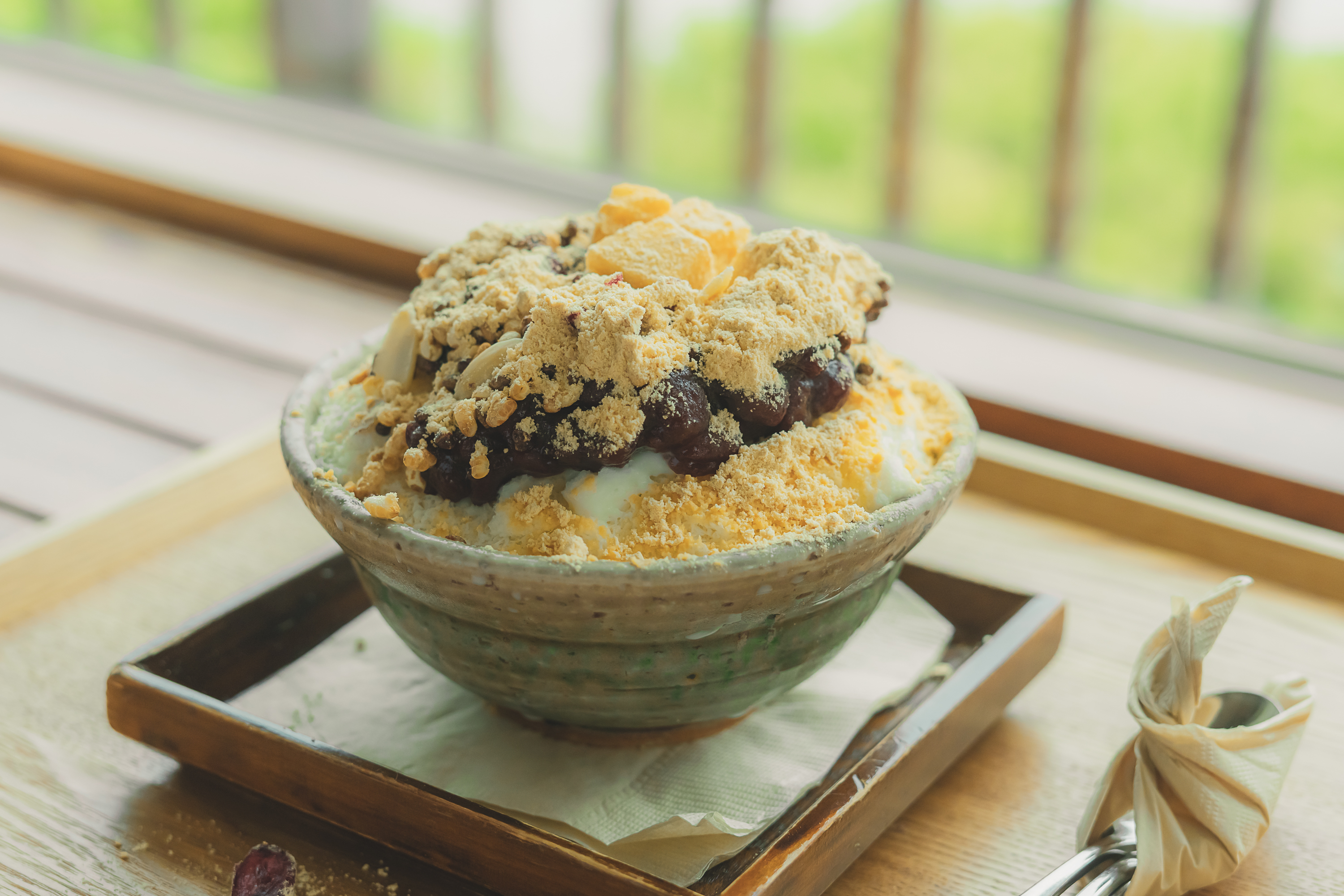
Bingsu began centuries ago as a royal summer delicacy in Korea. Today it is the icon of Seoul's café culture — not watery crushed ice, but soft milk snow, shaved fine as powder and piled high. On top go sweet red beans, chewy rice cake, and a generous dusting of roasted soybean powder. That final nutty layer is what this pouch is for.
Injeolmi bingsu at a Korean café — milk snow, red bean, roasted soybean powder.Skip the ingredient hunt
Most bingsu recipes send you searching — roasted soybean powder from a Korean market, condensed milk, sugar, red bean… We blended them all, the way Korean dessert shops do. One pouch. Zero hunting.
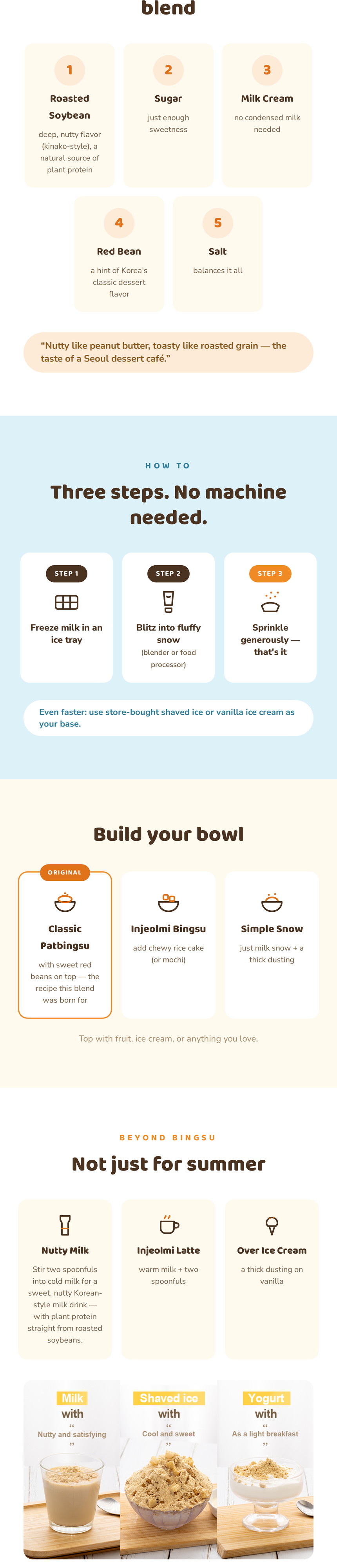
Five ingredients, one perfect blend
Three steps. No machine needed.
(blender or food processor)
Build your bowl
Not just for summer

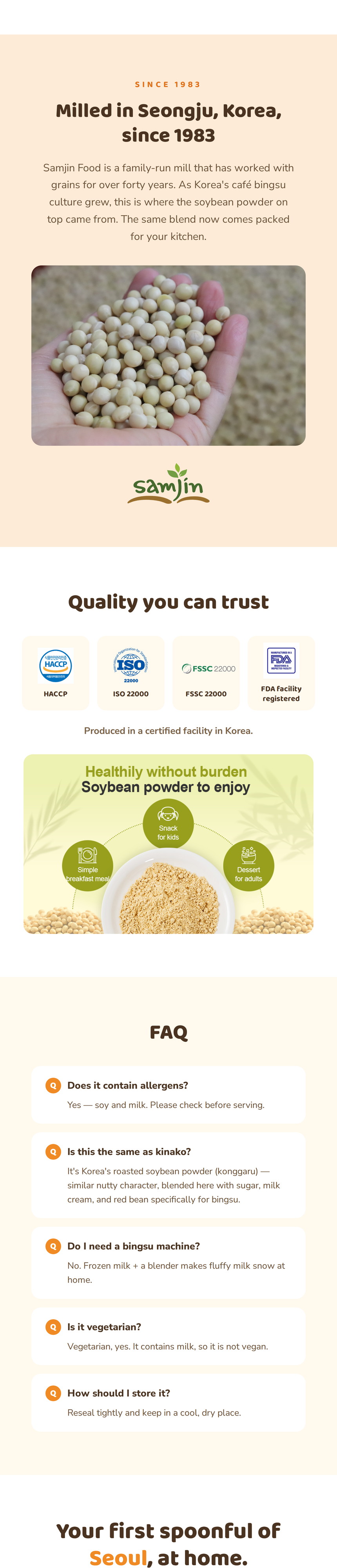
Milled in Seongju, Korea, since 1983
Samjin Food is a family-run mill that has worked with grains for over forty years. As Korea's café bingsu culture grew, this is where the soybean powder on top came from. The same blend now comes packed for your kitchen.
Quality you can trust
HACCP
FAQ
Your first spoonful of Seoul, at home.